
Healing via mind-brain-body rewiring
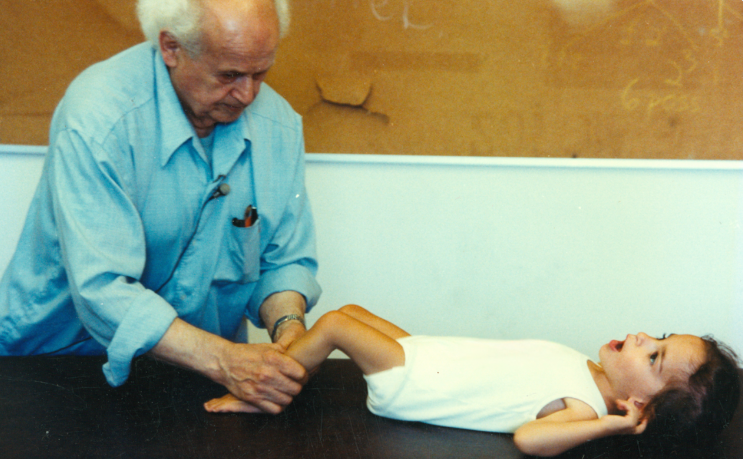
The most exciting field of mind-body science today is “Neuroplasticity,” which Moshe Feldenkrais pioneered after WWII. A black belt in Judo as well as a scientist, Feldenkrais demonstrated that our ability to heal and self-improve through moving mindfully “has no limit”. Now that’s inexhaustible potential!
Please join me for an exciting online gathering this Saturday, November 15! Discover mindful movement from an angle you may not have considered: the remarkable Feldenkrais method. We’ll hear how Moshe Feldenkrais used mindful movement to help a little girl born missing part of her brain, expected to live as a vegetable, to grow into a fully functioning adult with husband, children, and a job!
Feldenkrais teacher and film-maker Alice Boyd will share some of the life story and work of Moshe Feldenkrais, and how he discovered his revolutionary healing method that reorganizes the brain, reduces pain, and allows people to function better than before. Alice will even do a bit of Feldenkrais movement with us!
The Gems weekly conversation circle begins with my live interview with Alice, followed by rich group dialogue, giving you space to share your thoughts and expertise. Please enjoy reading the abbreviated story below of Moshe Feldenkrais working with stroke victim Nora to hugely improve her brain-body connection.
See you on Saturday with our special guest, Alice Boyd, who is offering us a short Feldenkrais movement experience, plus a sneak preview of her film – the first documentary on Moshe Feldenkrais’ life and work!
Moving Mindfully with you,
Rénee Tillotson
————————————Moshe Feldenkrais————————————
— A compilation of excerpts from The Brain’s Way of Healing by Norman Doidge
Moshe Feldenkrais met a woman in her sixties, Nora, who had had a stroke on the left side of her brain. In a stroke, a blood clot, or a bleed, cuts off blood supply to the neurons, and they die. In Nora’s case, her speech was slow and slurred, her body stiff. She wasn’t paralyzed, but her muscles were spastic on one side. It’s a classic sign of a poorly modulated nervous system.
A year after the stroke, Nora’s speech had improved, but she couldn’t read a word or write her own name. After two years, she still required around-the-clock monitoring, because she’d often go out and be unable to find her way home. She was deeply depressed about her loss of mental functions.
Feldenkrais first met her three years into her illness and had no idea of how he would approach her problem. Every stroke with cognitive problems is unique, and figuring out exactly which brain function is damaged often requires the skill of a detective. He understood that reading is not natural-the learning process requires wiring together many different brain functions. He also understood that when a stroke affects a neuronal network that processes a function, it does not mean the entire network is damaged: “When a skill cannot be performed as before, only some of the cells which were essential to the skill performance do not function.” It was often possible to recruit other neurons and to teach them to differentiate “to perform the skill, though usually in a different manner.”
In his early work with Nora, Feldenkrais was trying to find out why she couldn’t read and write. He also wondered about her body awareness and orientation: she kept bumping into things; when she tried to sit on a chair, she often sat on the edge of the seat; when she left his room, which had several doors, she often chose the wrong one. At the end of one half-hour lesson, he put her shoes, which she had taken off for the lesson, in front of her feet, with the toes facing her, without telling her why. She looked very confused, couldn’t put them on, couldn’t tell her right shoe from the left, and fumbled for five or six minutes. This mistake told him that her brain damage was preventing her from telling left from right, which would also interfere with her ability to read. He would have to deal with the left-right problem first because children must learn to differentiate left from right long before they can learn to read.
But before he could address Nora’s orientation problem, he had to quiet her noisy, hyper-excited brain… [long explanation of Feldenkrais’ use of subtle, highly differentiated movements to treat Nora follows here]
After three months, he taught Nora to hold a pen and write using other ingenious techniques. She continued to improve, the lessons ended, and she returned to Switzerland.
One year later, on a visit to Switzerland, Feldenkrais spotted Nora walking near the railway station in Zurich. She looked confident. When they spoke, he was delighted to find that the teacher-pupil relationship was over, replaced by the ordinary ease of two friends bumping into each other.
When Feldenkrais agreed to work with Nora, he was overwhelmed by the fact that she had lost brain structure, because he knew her brain was plastic; he couldn’t know what her limits might be before trying patiently to teach her to re-create her orientation, then to read and write, as one might teach a child. The key to her progress was his recognizing which brain function was missing, then teaching her to make sensory differentiations. As her mind – her awareness – noticed these differences, they were wired into her brain maps, and she became ready to make even finer differentiations.
There is great beauty in the image of these two elderly people, Feldenkrais, about seventy, sitting by Nora’s side, the one teaching the other how to read, their nervous systems so intertwined and attuned, he learning, as he would write, as much as she. But Feldenkrais was very careful about the words he used to describe what he did with Nora. It was not, he said, a “recovery.” “Recovery is not the right word,” he wrote, “since the part of the motor cortex where writing is organized and directed was not in a state to perform as before. The better word is ‘recreating’ a writing ability.” Because the brain map circuits originally involved in reading and writing were damaged by her stroke, those functions had to be taken over by other neurons.
He didn’t call what he did with Nora a “cure,” even though many would have. ‘Cure’ is a return to the previously enjoyed state of activity which need not have been excellent or even good. He preferred the term improvement. “‘Improvement,”‘ he wrote, “is a gradual bettering which has no limit.”